 Pagal World
Modern rubber injection molding production is no longer judged only by injection volume or cycle speed. Clamping force and usable mold size have become central because part dimensions, cavity layout, and curing pressure directly affect machine selection. When a rubber injection molding machine is undersized in either area, mold planning becomes restricted and production stability can suffer.
For B2B manufacturers, this issue becomes more important when products grow longer, wider, or more complex. Suitable rubber molding equipment must accommodate the physical mold while also supplying enough force to keep it closed during filling and curing. These two factors should be reviewed together rather than treated as separate specifications.
Why Clamping Force Deserves More Attention
Clamping force keeps the mold closed while rubber enters the cavities under pressure. The required force is related to projected molding area, cavity pressure, mold structure, and cavity count. Larger parts or multi-cavity tools can increase force demand even when injection volume appears suitable.
Insufficient force may allow the mold halves to separate slightly during the cycle. This can contribute to flash, unstable dimensions, or extra trimming work. The problem becomes more visible on large components because projected area can rise quickly as product dimensions increase.
More force is not automatically a better choice. Oversizing can raise machine investment and may place unnecessary load on the mold and clamping system. Production teams need a realistic force range based on actual tool design, material behavior, and expected process pressure.
Mold Size Changes the Machine Selection Logic
Physical mold dimensions create another limit. Buyers need to compare the tool with platen size, mounting area, opening space, and part removal requirements. Even when a mold fits dimensionally, installation, opening, servicing, or removal may still be difficult.
Tooling layout also affects how much production capacity fits inside the available machine space. Designers may need room for runners, heating areas, venting structures, inserts, or handling devices. These elements can enlarge the tool beyond the dimensions of the finished rubber part.
This is why machine selection should begin with actual mold drawings rather than only a product sample. When reviewing rubber molding equipment, engineering teams should check tool length, width, thickness, opening direction, mounting method, and removal path before confirming a configuration.
Force and Mold Geometry Need to Work Together
Clamping force and mold size influence each other through projected area. Increasing cavity count can improve output per cycle, but it can also enlarge the mold and raise the total force needed to keep the tool closed. Productivity targets therefore have to be checked against machine capacity.
Part geometry creates similar trade-offs. Long products, broad sealing surfaces, or large insulation components may need greater platen space even when material volume is moderate. Complex cavities can also change filling behavior, making pressure control and mold closure more important during process development.
For this reason, buyers should avoid selecting a rubber injection molding machine from clamping force alone. Injection capacity, mold dimensions, opening stroke, material characteristics, and production layout should be reviewed as one system. This reduces the risk of tool-machine conflicts after equipment ordering.
Power Components Show Why Size Matters
Electrical insulation products illustrate the issue clearly. Hollow core insulators and long rod insulators can require extended mold dimensions. Surge arresters, cable accessories, and switchgear components may also involve different lengths, profiles, and material volumes. Machine configuration must reflect these variations.
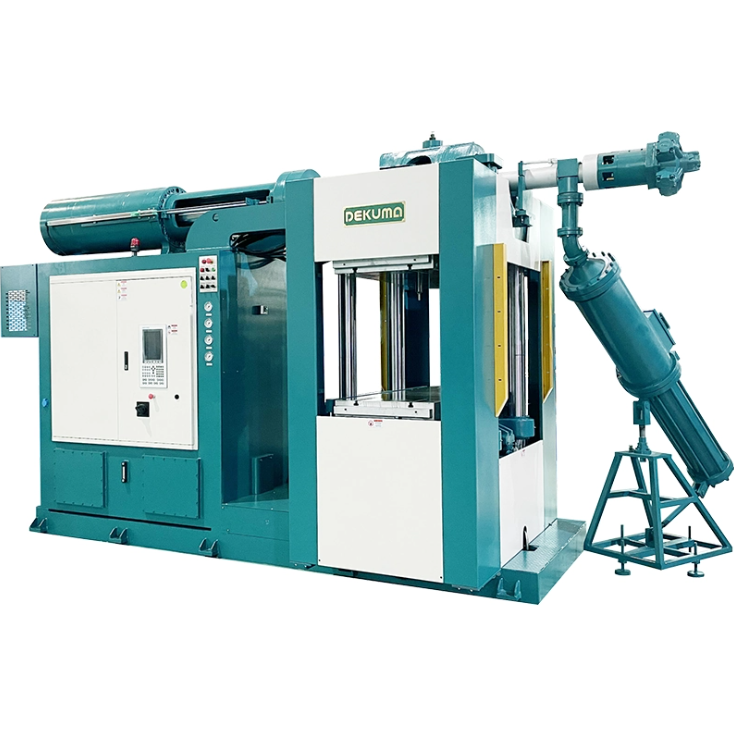
For this application area, Dekuma offers the RA Series for hollow core insulators, long rod insulators, surge arresters, cable accessories, and switchgear. The RA Series processes silicone rubber and EPDM for applications such as insulators, surge arresters, cable accessories, and switchgear.
Industry experience, patents, and certifications also support the development of this product line. The example shows why general machine size alone does not tell buyers whether a system matches a specific molding task. Product geometry, material behavior, and mold structure still need to be reviewed together.
What Buyers Should Check Before Ordering
Procurement teams should request mold data before comparing machine quotations. Useful information includes overall mold dimensions, projected cavity area, part weight, cavity count, planned material, expected cycle method, and the way finished parts will be removed. These details give suppliers a clearer basis for machine sizing.
Engineering teams should also consider future tooling plans. Equipment selected only for one current mold may become restrictive when a larger part or additional cavity layout is introduced later. Reasonable capacity margin can help, but it should be based on realistic production plans rather than vague expansion assumptions.
Supplier discussions should connect the mold to the full process. Dekuma provides turnkey rubber injection molding solutions and develops equipment for specific industrial applications. For buyers, the practical value lies in matching machine structure to tooling and production requirements before installation.
Practical Basis for Equipment Decisions
The final choice of rubber injection molding machine should account for mold dimensions, material characteristics, clamping requirements, part-removal methods, and production targets. Reviewing these factors early can reduce tooling conflicts and support equipment selection.
